Achiever (D): DISC Personality Type
You head straight for the goal and move fast: you take the initiative, decide without lengthy discussion and aren’t afraid of pushback. Being in control and seeing measurable results matter to you.
What the result looks like
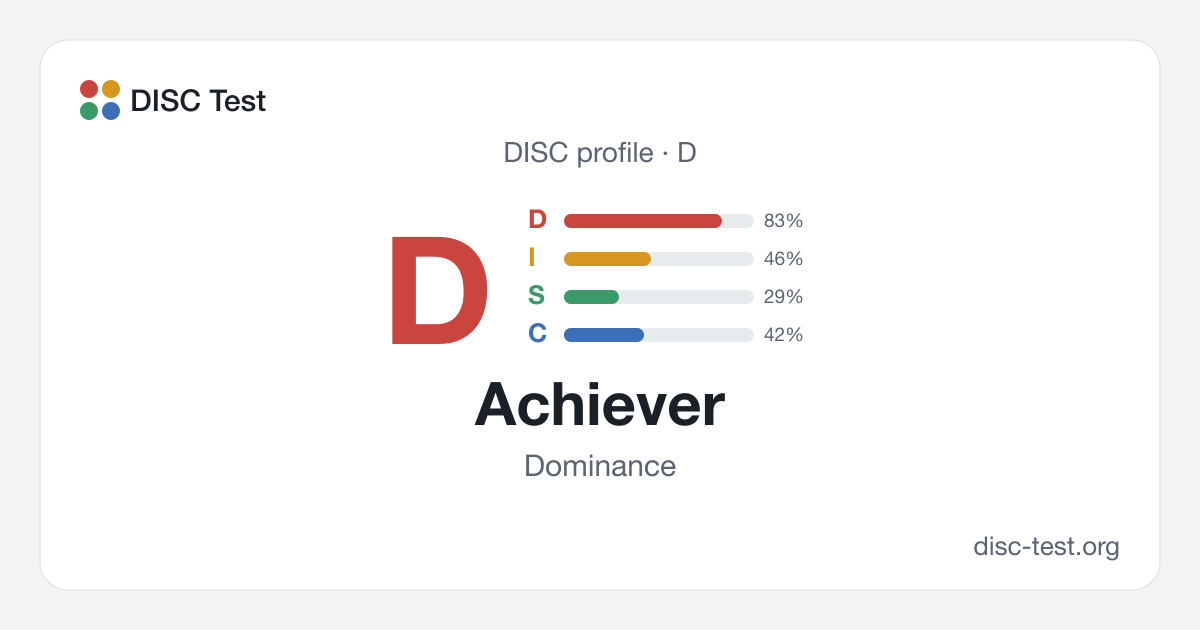
A sample profile for the “Achiever” type: the intensity of the four styles in percent; values above 50% are considered high. Your chart will differ in the details, but the shape is similar.
DISC profile
Style intensity
How it differs from similar profiles
A pure D differs from the blended profiles in having no “softener.” In the Pioneer (DI), drive is tempered by charm; in the Strategist (DC), by calculation; in the Doer (DS), by patience. The Achiever acts directly: they see the goal, pick the shortest route and spend no energy on being liked or double-checking everything. What sets them apart from the Implementer (SD) and the Perfectionist (CD), where D comes second, is pace: they don’t wait for conditions to be right; they create them.
Primary style: Dominance (D)
Results and control.
The Achiever at work
At work the Achiever stands out right away: they’re the first to say what needs doing, they take on the hardest task, and they ask about deadlines before details. They do their best work where there’s a measurable goal and freedom to choose how to reach it: a sales target, a launch, a crisis, a negotiation. Routine and sign-offs wear them out, and they’re quick to find ways around them. When everything is going to plan they get bored, so they often go looking for the next challenge themselves.
Suitable roles and tasks
- Head of a department or project
- Entrepreneur, founder
- Crisis manager
- Head of sales, negotiator
- Chief operating officer
On a team
Takes the lead even when nobody appointed them, sets goals and pushes the team toward results. Indispensable when an unpopular decision has to be made or a project pulled out of a crisis. With them the team moves fast, though not always comfortably, so make sure the cautious voices are heard too.
The Achiever as a leader
As a leader, the Achiever sets ambitious goals, makes decisions quickly and takes the blame for failures. The team knows where it’s headed and moves fast. The weak spot is that they decide for everyone: they don’t ask for input, they interrupt, and they take silence for agreement. Independent, assertive people thrive in their department, while cautious, reflective ones fade into the background or leave altogether.
What they need from a manager
The Achiever needs a manager who sets the goal and stays out of how it gets reached. They value directness, quick answers and recognition of results rather than effort. Micromanagement, drawn-out approvals and vague assignments irritate them and tempt them to work around the system. What works well is a clear deal: here’s the goal, here are the limits, here’s the deadline, the rest is up to you.
Under pressure and in conflict
Under pressure the Achiever speeds up and hardens: they speak more tersely and sharply, start doing other people’s work and take decisions away from others. In conflict they go on the attack and treat an argument as a contest to be won. They cool down quickly and rarely hold a grudge, but other people remember what was said longer than they do.
Areas to develop
- Asking “What do you think?” before announcing their own decision
- Telling colleagues’ caution apart from sabotage
- Noticing and naming other people’s contributions, not just the result
- Finishing the boring part of the work or honestly delegating it
How to communicate with other styles
With Dominance (D)
With another D, divide areas of responsibility in advance and argue about criteria, not about who’s in charge.
With Influence (I)
Spend a couple of minutes on small talk before getting down to business, and acknowledge their contribution out loud.
With Steadiness (S)
Slow down, give advance notice of changes, and wait for the answer to your question without filling the pause.
With Conscientiousness (C)
Back your decisions with facts and allow time for checking. For a C, that isn’t stalling; it’s the job.
How to reach agreement
Keep it short and to the point with the Achiever: goal, benefit, options, deadline. Don’t argue with them emotionally; argue with facts and offer a choice rather than a single solution. If you need to stop them, show how haste puts the result at risk. That’s an argument they’ll listen to.
A real-world example
A project is a month behind. The Achiever pulls the team together, reassigns tasks in ten minutes, cancels two approval steps and calls the client personally. Within a week the project is back on schedule, but two team members complain they weren’t consulted, and in the rush a mistake in the contract slipped through. The same result without the fallout would have taken just another half hour spent on the question “What risks am I not seeing?”
DISC style compatibility: all pairs →
Similar profiles
Drive and charm: you move quickly toward the goal and know how to bring people along. You win people over…
DCStrategistDC · Dominance + ConscientiousnessResults through quality: you are demanding of yourself and others, think systematically and never decide…
DSDoerDS · Dominance + SteadinessPersistence and reliability: you push steadily toward the goal without any fuss and finish what you start.…
Other DISC profiles
I EnthusiastID MotivatorIS MentorIC PresenterS AnchorSI DiplomatSC SpecialistSD ImplementerC AnalystCD PerfectionistCS ExpertCI Consultant