Mentor (IS): DISC Personality Type
Warmth and engagement: you win people over, and you know how to support them and bring them together. Relationships and atmosphere matter to you, while conflict and harsh demands are hard to take.
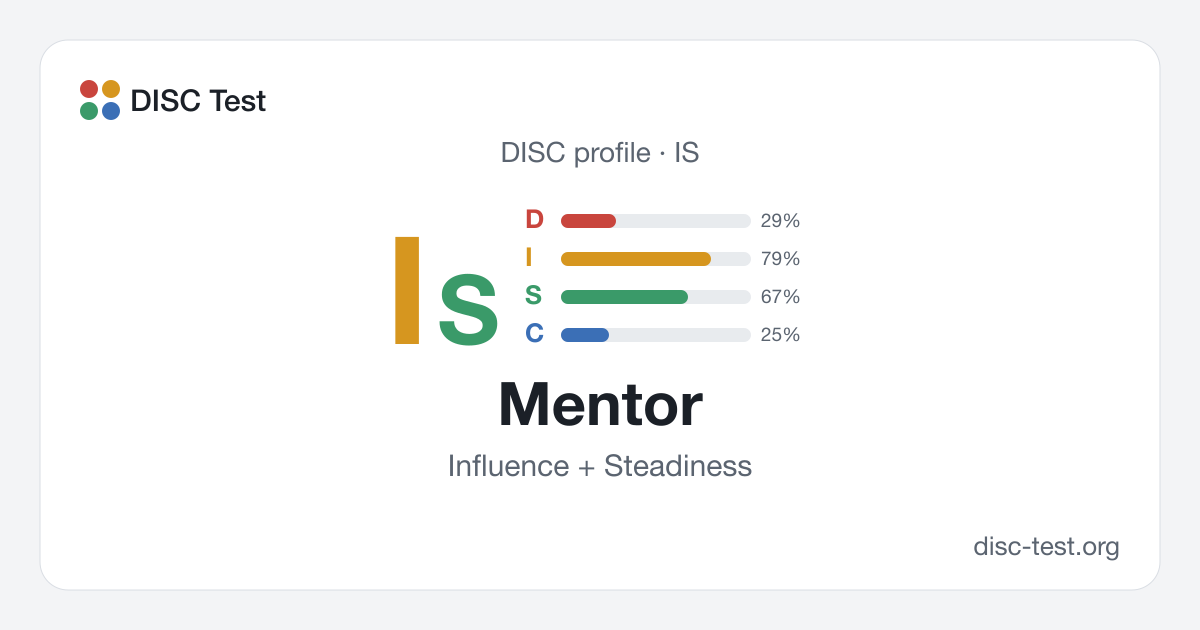
What the result looks like
A sample profile for the “Mentor” type: the intensity of the four styles in percent; values above 50% are considered high. Your chart will differ in the details, but the shape is similar.
DISC profile
Style intensity
How it differs from similar profiles
The Mentor differs from the Diplomat (SI) in the order of the letters: warmth and sociability come before calm, so they’re more active — they introduce themselves, bring people together and steer the conversation. What sets them apart from the Enthusiast (I) is care rather than flair: it matters more to them that people feel good than that things are exciting. From the Motivator (ID): no push. They lead people through support, not through goals.
Primary style: Influence (I)
People and enthusiasm.
Secondary style: Steadiness (S)
It gives your primary style more patience, reliability and attention to the team.
The Mentor at work
At work the Mentor is the one people come to with questions and problems. They onboard newcomers, smooth relations between departments and remember whose birthday it is and who’s on vacation. They’re happiest working with people: training, onboarding, client support, a team that values relationships. Tough decisions, competition and work without human contact are hard on them.
Suitable roles and tasks
- Mentor, coach, teacher
- HR business partner, onboarding and training
- Key account management
- Head of a service or close-knit team
- Mediator, facilitator
On a team
The one people go to when they need to talk: listens, supports, connects people and keeps the atmosphere warm. With them the team is friendlier and more resilient. Tough decisions and unpleasant conversations come hard; they should remember that honest feedback is a form of care too.
The Mentor as a leader
As a leader, the Mentor develops people: they see potential, offer support and give second chances. On their team it’s safe to make mistakes and learn. The weak spots are avoiding tough feedback and unpopular decisions: they put up with weak performance for a long time and may defend a team member longer than they should.
What they need from a manager
The Mentor needs a kind, supportive manager who values their contribution to the atmosphere and to people, not just the numbers. They work well when they feel trusted and can discuss decisions. A cold tone, public criticism and pressure without explanation drain them faster than any workload.
Under pressure and in conflict
Under pressure the Mentor looks for support and tries to reconcile everyone. They agree to things so as not to upset people and may promise opposite things to different sides. If a conflict drags on, they take it to heart and lose energy; they avoid open confrontation until the very last.
Areas to develop
- Giving honest feedback, remembering that it’s a form of care too
- Making decisions that not everyone will like
- Separating the wish to help from an obligation to solve other people’s problems
- Relying on facts, not just their impression of a person
How to communicate with other styles
With Dominance (D)
Keep business talk brief, don’t take their directness to heart, and voice disagreement right away.
With Influence (I)
Support the ideas, but ask for a plan and deadlines, or you’ll both get carried away.
With Steadiness (S)
Name problems out loud and set deadlines for each other; otherwise nothing moves.
With Conscientiousness (C)
See their criticism of details as a commitment to quality, not a judgment of you.
How to reach agreement
Take a warm tone with the Mentor: show how the decision will affect people and how you’ll support them. Ask for their opinion; they often see how the team will take a change. If a tough decision is needed, explain why it’s fair and help them work out how to tell people about it.
A real-world example
One of the Mentor’s team members has been missing deadlines for three months. The Mentor helps them, takes on some of their tasks and covers for them with leadership. When the problem surfaces with a client, it turns out the person simply isn’t up to the role. An honest conversation in the very first month would have helped find them a better-suited role sooner, at no cost to the team.
DISC style compatibility: all pairs →
Similar profiles
Calm and friendliness: you create an atmosphere of trust, smooth over rough edges and support the team.…
IEnthusiastI · InfluenceYou get things done through people: you make connections easily, spread enthusiasm and win people over with…
IDMotivatorID · Influence + DominanceEnergy and drive: your enthusiasm for ideas is contagious, and you aren’t afraid to take the initiative. You…
ICPresenterIC · Influence + ConscientiousnessEloquence and precision: you can convincingly present a well-thought-out position. You combine sociability…
Other DISC profiles
D AchieverDI PioneerDC StrategistDS DoerS AnchorSC SpecialistSD ImplementerC AnalystCD PerfectionistCS ExpertCI Consultant