Anchor (S): DISC Personality Type
You create stability: you keep your word, finish what you start, support people and smooth over conflicts. Predictability, trust and time to get used to change matter to you.
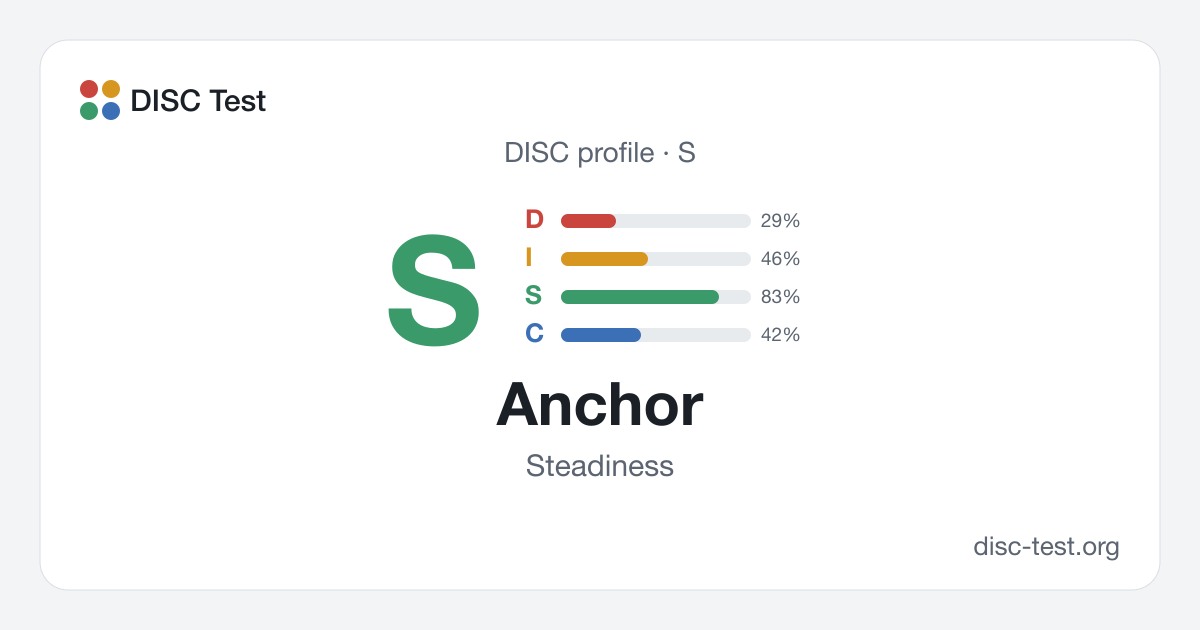
What the result looks like
A sample profile for the “Anchor” type: the intensity of the four styles in percent; values above 50% are considered high. Your chart will differ in the details, but the shape is similar.
DISC profile
Style intensity
How it differs from similar profiles
The Anchor is a pure S: what matters most to them is stability and relationships. In the Diplomat (SI), calm comes with sociability; in the Specialist (SC), with a love of rules; in the Implementer (SD), with persistence in reaching a goal. The Anchor holds the middle ground: they don’t rush ahead, seek attention or build systems; they simply make sure everything works and people feel secure. What sets them apart from the Expert (CS) and the Mentor (IS) is that stability matters more to them than either precision or socializing.
Primary style: Steadiness (S)
Support and stability.
The Anchor at work
At work the Anchor often goes unnoticed until they go on vacation. They remember who promised what, help newcomers, answer the questions nobody else wants to deal with and finish the projects others have forgotten. They’re happiest where processes are clear, the team is stable and results are measured by reliability rather than speed. Frequent reorganizations and constant firefighting wear them down.
Suitable roles and tasks
- Client support and account management
- Coordinator, project administrator
- Mentor, teacher
- Medicine, social work, caregiving
- Operational and service roles with steady processes
On a team
The person everyone relies on: sees things through, remembers what was agreed, helps newcomers and smooths over conflicts. Often holds the team together without anyone noticing. Risks going unrecognized and being overloaded with other people’s tasks because they find it hard to say no.
The Anchor as a leader
As a leader, the Anchor is attentive and fair: they know every team member, protect the team and don’t abandon anyone in a tough moment. Their teams have low turnover and a calm atmosphere. The weak spots: they put off unpopular decisions, rarely give tough feedback and take on their reports’ work so as not to overload them.
What they need from a manager
The Anchor needs a manager who gives advance notice of changes, explains the reasons for them and allows time to adjust. They value a calm tone, clear expectations and appreciation for behind-the-scenes work. Sudden changes of course, shouting and public pressure undermine their trust for a long time, even if they say nothing.
Under pressure and in conflict
Under pressure the Anchor slows down and goes quiet. They agree to avoid an argument, take on even more and quietly build up resentment that others don’t notice. In conflict they step aside or give in, and if the pressure goes on for a long time, they may unexpectedly dig in or resign. It seems “sudden” to everyone else, though for them the decision was made long ago.
Areas to develop
- Saying “no” to new tasks when already overloaded
- Voicing disagreement right away, while it’s still small
- Trying new things in small steps without waiting to feel completely sure
- Talking about their results instead of waiting for others to notice
How to communicate with other styles
With Dominance (D)
Voice disagreement right away and keep it brief; ask for clear priorities instead of guessing.
With Influence (I)
State your boundaries out loud and ask for a plan — an idea alone isn’t enough for you.
With Steadiness (S)
Set deadlines for each other and take turns being the one who decides.
With Conscientiousness (C)
Read their critical feedback as a commitment to quality, and propose changes in small steps.
How to reach agreement
Approach the Anchor calmly and well in advance. Explain what’s changing and why, what will stay the same and how you’ll support them. Don’t demand an answer on the spot: give them a day to think it over, and ask for their opinion one-on-one rather than in a group meeting. Their “yes” after a pause is more reliable than a quick “yes” under pressure.
A real-world example
The company switches to a new accounting system. The Anchor quietly learns it in the evenings, helps colleagues and complains to no one. A month later it turns out they’ve been doing the work of one and a half people and are planning to leave. Had the manager asked earlier, “How’s the switch going? What’s getting in your way?”, they would have learned about the problem three weeks before the resignation letter.
DISC style compatibility: all pairs →
Similar profiles
Calm and friendliness: you create an atmosphere of trust, smooth over rough edges and support the team.…
SCSpecialistSC · Steadiness + ConscientiousnessReliability and accuracy: you work methodically, follow the rules and see things through without haste. You…
SDImplementerSD · Steadiness + DominancePerseverance and patience: you calmly but firmly see things through without getting caught up in needless…
Other DISC profiles
D AchieverDI PioneerDC StrategistDS DoerI EnthusiastID MotivatorIS MentorIC PresenterC AnalystCD PerfectionistCS ExpertCI Consultant