Analyst (C): DISC Personality Type
You rely on facts and standards: you check, analyze, plan and dislike hasty decisions. Quality and getting it right matter more to you than speed or making an impression.
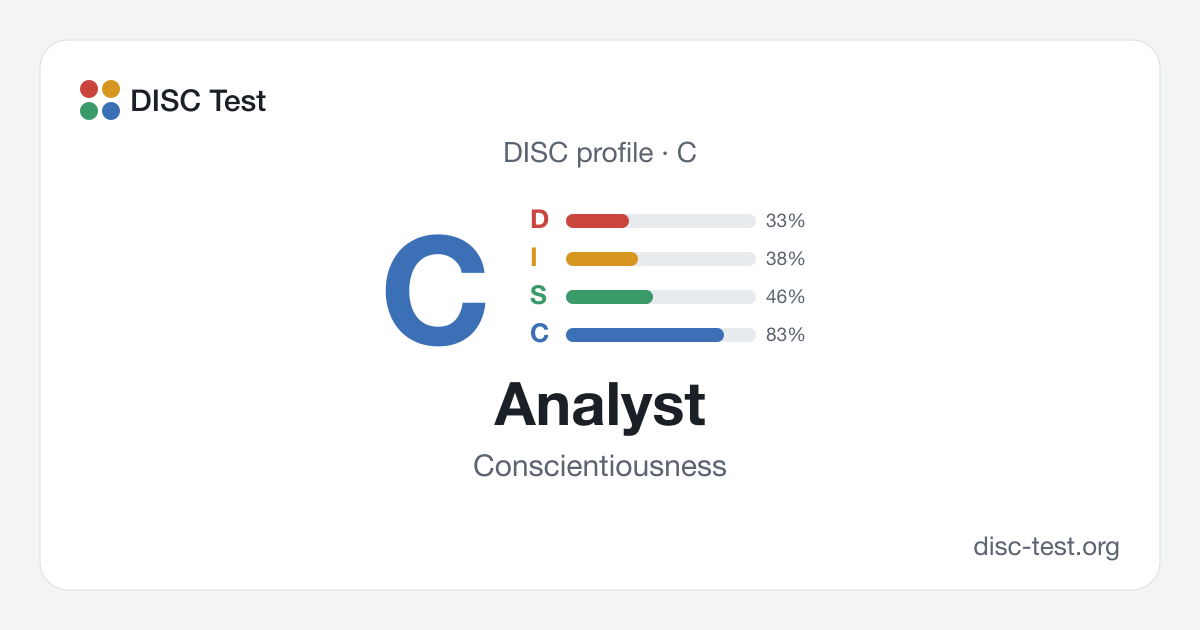
What the result looks like
A sample profile for the “Analyst” type: the intensity of the four styles in percent; values above 50% are considered high. Your chart will differ in the details, but the shape is similar.
DISC profile
Style intensity
How it differs from similar profiles
The Analyst is a pure C, guided by logic and quality. The Perfectionist (CD) adds demandingness and drive to precision; the Expert (CS) adds patience and method; the Consultant (CI) adds a desire to explain and share. The Analyst, above all, wants to understand things and get them right. What sets them apart from the Strategist (DC) and the Presenter (IC), where C is secondary, is that getting it right matters more to them than either speed or making an impression.
Primary style: Conscientiousness (C)
Accuracy and quality.
The Analyst at work
At work the Analyst is the one who reads documents to the end, asks awkward questions and finds the mistake everyone else missed. They do their best work with data, systems, standards and tasks where the cost of an error is high. They need time, quiet and clear criteria. Guesswork, constant task-switching and decisions without justification make them bristle inside.
Suitable roles and tasks
- Analyst, researcher
- Finance, audit, accounting
- Engineer, developer, tester
- Lawyer, compliance, quality control
- Process and systems architect
On a team
Makes sure what gets done actually works: checks, finds mistakes before clients do, and plans for risks. With them the team is more accurate but slower. They should explain the logic of their requirements to colleagues and sometimes settle for “good enough.”
The Analyst as a leader
As a leader, the Analyst builds processes, sets clear standards and makes well-founded decisions. Their team has little chaos and little rework. The weak spots: they take a long time to decide, control the details, criticize more than they praise and may not notice that people are missing warmth and recognition.
What they need from a manager
The Analyst needs a manager who sets tasks clearly and in writing, explains the quality criteria and doesn’t demand an answer “right now.” They value competence and logic over charisma. Vague instructions, requirements that change without explanation and criticism without specifics erode their trust fastest.
Under pressure and in conflict
Under pressure the Analyst retreats into details: they double-check, gather more data, put off the decision and become withdrawn and critical. In conflict they argue with evidence and quote the rules, and if the arguments don’t work, they go silent and stick to their position. They read an opponent’s emotional pressure as a sign of a weak case.
Areas to develop
- Making decisions with incomplete information when the cost of a mistake is low
- Separating what matters from what doesn’t, and not polishing what’s already good enough
- Starting feedback with what was done well
- Sharing work in progress, not just finished results
How to communicate with other styles
With Dominance (D)
Offer a “good enough for now” option and report risks briefly, along with their consequences.
With Influence (I)
Start by acknowledging the idea, and explain your conclusions in plain language.
With Steadiness (S)
Soften criticism and acknowledge their contribution out loud — for an S, the atmosphere is part of the result.
With Conscientiousness (C)
Agree in advance on what level of quality is good enough, and limit the time for analysis.
How to reach agreement
Come to the Analyst with numbers, documents and clear logic. Send materials in advance so they have time to study them. Answer their questions even if they seem petty: that’s how they check whether a decision has been thought through. If you’re rushing them, explain why speed matters more here than a full review.
A real-world example
Before a client report goes out, the Analyst spots a 3% discrepancy in the data. The manager says, “Just send it as is, nobody will notice.” The Analyst spends three hours tracking down the cause and finds an error in the data export that would have skewed every future report. The deadline slips by half a day, and this is an argument they were right to win. But another time the same habit will hold up a project over a comma in an appendix.
DISC style compatibility: all pairs →
Similar profiles
Standards and willpower: you demand precision from yourself and others, spot mistakes quickly and aren’t…
CSExpertCS · Conscientiousness + SteadinessPrecision and consistency: you work thoughtfully, check the details and rely on proven methods. A dependable…
CIConsultantCI · Conscientiousness + InfluenceAnalysis and connection: you can get to the bottom of a question and explain it to others in plain terms. A…
Other DISC profiles
D AchieverDI PioneerDC StrategistDS DoerI EnthusiastID MotivatorIS MentorIC PresenterS AnchorSI DiplomatSC SpecialistSD Implementer