Strategist (DC): DISC Personality Type
Results through quality: you are demanding of yourself and others, think systematically and never decide without solid reasoning. You excel at complex tasks, but can come across as cold and overly critical.
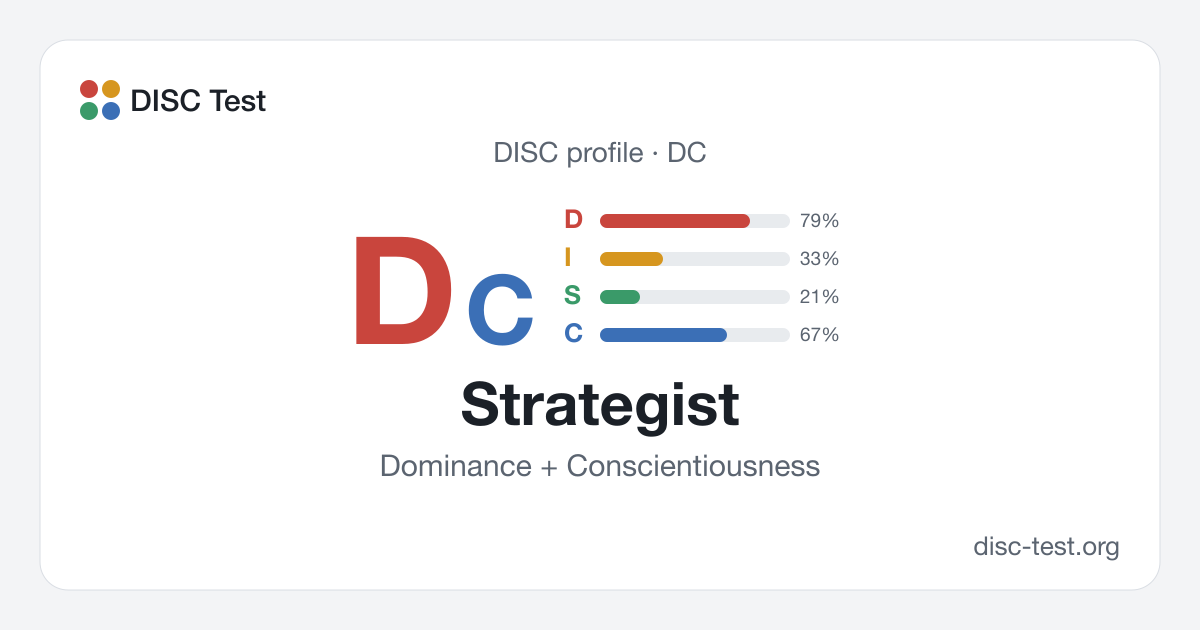
What the result looks like
A sample profile for the “Strategist” type: the intensity of the four styles in percent; values above 50% are considered high. Your chart will differ in the details, but the shape is similar.
DISC profile
Style intensity
How it differs from similar profiles
The Strategist combines the drive of D with the precision of C, and that’s what distinguishes them from their neighbors. The Perfectionist (CD) starts with quality and only then pushes; the Strategist starts with the goal and demands quality on the way to it. What sets them apart from the Achiever (D) is calculation: they don’t charge in until they can see a plan. From the Pioneer (DI): less charm and more argument. They persuade with logic, not enthusiasm.
Primary style: Dominance (D)
Results and control.
Secondary style: Conscientiousness (C)
It gives your primary style more precision, caution and reliance on facts.
The Strategist at work
At work the Strategist takes on complex, high-stakes tasks: a reorganization, a system rollout, tough negotiations, a project that has to be both fast and error-free. They build a plan, weigh the risks and hold themselves and others to a high bar. They can’t stand incompetence or winging it. Talk without results and decisions made on a whim irritate them.
Suitable roles and tasks
- Manager of complex projects
- Business development director, strategist
- Head of an engineering or analytics team
- Management consultant
- Chief financial officer
On a team
Combines drive and quality: sets a high bar and reaches it, thinks in systems, sees risks before others do. With them the team is focused and productive, but people may sense a certain coldness and feel constantly evaluated. They should acknowledge people’s contributions more often and explain decisions rather than only make demands.
The Strategist as a leader
As a leader, the Strategist is demanding, fair and predictable: goals are clear, standards are high, mistakes get analyzed. Teams grow professionally under them. The weak spots are coldness and constant evaluation: they rarely praise, are quick to spot slip-ups and can leave people feeling that what they’ve done is never enough.
What they need from a manager
The Strategist needs a competent manager they respect: one with a clear strategy, a logic behind decisions and a willingness to argue on the merits. They value autonomy and access to complete information. Decisions without justification, uninformed interference and “that’s how it’s done here” trigger open resistance.
Under pressure and in conflict
Under pressure the Strategist becomes tougher and more critical: they point out mistakes sharply, take control and stop explaining. In conflict they argue logically and persistently, won’t give ground without good reasons and may win the argument at the cost of the relationship. At such moments they reject emotional arguments.
Areas to develop
- Acknowledging people’s contributions out loud, not just correcting mistakes
- Explaining not only the “what” of a decision but also the “why”
- Allowing different ways to reach the goal if the result is the same
- Noticing when high standards start to demotivate the team
How to communicate with other styles
With Dominance (D)
Debate facts and criteria, and agree on who has the last word in contested areas.
With Influence (I)
Listen to ideas all the way through before taking them apart, and praise in public.
With Steadiness (S)
Explain why changes are needed and thank them for their reliability, since an S won’t ask for it.
With Conscientiousness (C)
Decide together where speed matters and where precision does, and don’t push deadlines where quality comes first.
How to reach agreement
Come to the Strategist prepared: goal, data, options with pros and cons, risks. They respect people who argue with evidence and lose interest in those who try to coax them. If you disagree, say so plainly and explain why; that earns more respect than giving in.
A real-world example
The Strategist is asked to bring order to a department that keeps missing deadlines. Within a month they introduce a work plan, weekly reviews and quality criteria. Deadlines are met, but two strong employees ask for a transfer: “All we get here is criticism.” When the Strategist starts recognizing successes in those same weekly reviews, the turnover stops and the results hold.
DISC style compatibility: all pairs →
Similar profiles
Standards and willpower: you demand precision from yourself and others, spot mistakes quickly and aren’t…
DAchieverD · DominanceYou head straight for the goal and move fast: you take the initiative, decide without lengthy discussion and…
DIPioneerDI · Dominance + InfluenceDrive and charm: you move quickly toward the goal and know how to bring people along. You win people over…
DSDoerDS · Dominance + SteadinessPersistence and reliability: you push steadily toward the goal without any fuss and finish what you start.…
Other DISC profiles
I EnthusiastID MotivatorIS MentorIC PresenterS AnchorSI DiplomatSC SpecialistSD ImplementerC AnalystCS ExpertCI Consultant