Presenter (IC): DISC Personality Type
Eloquence and precision: you can convincingly present a well-thought-out position. You combine sociability with attention to facts, but may waver between spontaneity and caution.
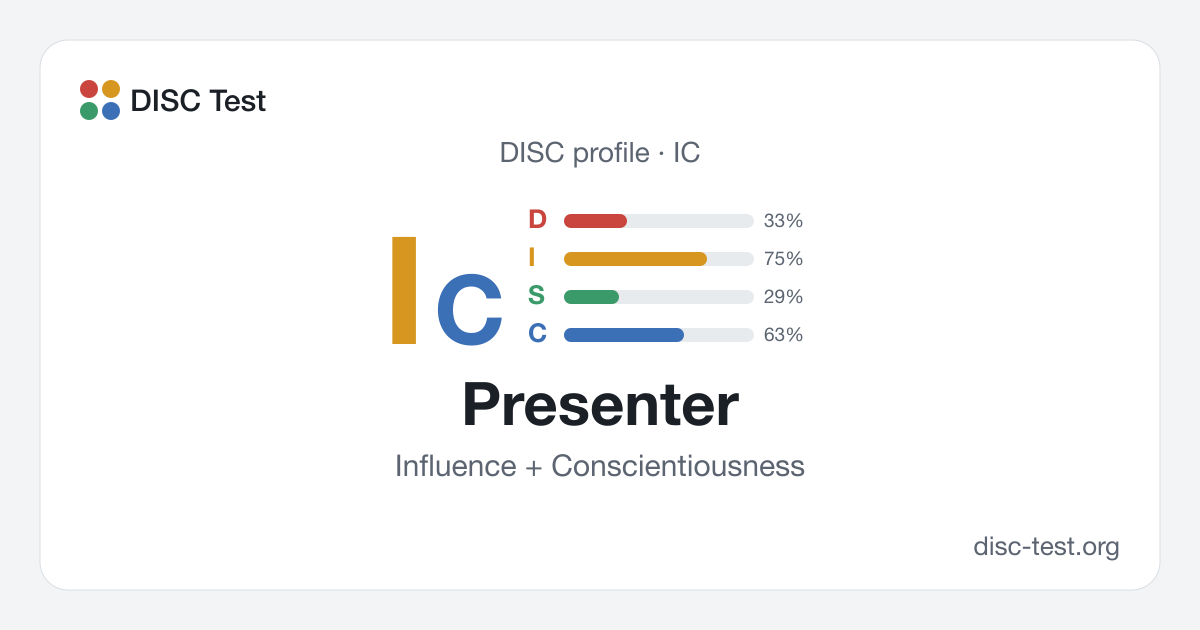
What the result looks like
A sample profile for the “Presenter” type: the intensity of the four styles in percent; values above 50% are considered high. Your chart will differ in the details, but the shape is similar.
DISC profile
Style intensity
How it differs from similar profiles
The Presenter differs from the Consultant (CI) in the order of the letters: communication comes before analysis, so they’ll present first and check afterward, whereas the Consultant checks first and explains afterward. What sets them apart from the Enthusiast (I) is a love of facts and preparation; from the Motivator (ID), a lack of push. They persuade with arguments and delivery, not pressure.
Primary style: Influence (I)
People and enthusiasm.
Secondary style: Conscientiousness (C)
It gives your primary style more precision, caution and reliance on facts.
The Presenter at work
At work the Presenter is the one who turns the complex into the clear: they prepare talks, write copy, explain the product to clients and present analysts’ findings to leadership. They’re strong where expertise meets an audience. It’s hard for them when they have to choose between speed and accuracy: they want both to present quickly and to check everything.
Suitable roles and tasks
- Marketing and product presentations
- Teacher, lecturer, author of training materials
- Consultant selling complex products
- Analyst who presents findings
- Communications and public relations
On a team
Knows how to explain: turns the complex into the clear and presents a well-considered position convincingly. Useful where experts meet their audience. Wavers between “say it” and “check it,” which can delay decisions; it helps to agree clearly on when speed matters and when precision does.
The Presenter as a leader
As a leader, the Presenter explains goals well, keeps communication going and watches quality. The team understands what it’s doing and why. The weak spot is wavering: they may take a long time choosing between options, revisit decisions when new data comes in and put off unpleasant conversations.
What they need from a manager
The Presenter needs a manager who lets them present and recognizes the quality of their work. They value clear criteria and a chance to prepare. It helps when it’s clear in advance where speed matters more and where accuracy does; that removes their inner conflict.
Under pressure and in conflict
Under pressure the Presenter wavers: at times they talk too much and too spontaneously, at others they retreat into double-checking. They may get touchy about criticism of how something was presented rather than of its substance. In conflict they first try to persuade with words, and if that fails, they step back and prepare stronger arguments.
Areas to develop
- Agreeing in advance when speed is needed and when accuracy is
- Making decisions on time, even when tempted to check once more
- Separating criticism of an idea from criticism of themselves
- Keeping it shorter when the audience needs a conclusion, not a story
How to communicate with other styles
With Dominance (D)
Start with the conclusion; keep the details and reasoning ready, but don’t open with them.
With Influence (I)
You’ll hit it off easily; just write down who does what and by when.
With Steadiness (S)
Don’t change plans on the fly, and ask for their opinion directly, giving them time to answer.
With Conscientiousness (C)
Speak the language of data and settle for “good enough” where the cost of a mistake is low.
How to reach agreement
Work things out with the Presenter through dialogue: discuss the idea, let them have their say and back up the decision with facts. Offer them a role presenting the results. Be clear about the deadline and the level of accuracy needed; it will keep them from getting stuck between “say it” and “check it.”
A real-world example
The Presenter is asked to present research findings to the board of directors. They spend three days reworking the slides, adding new data, and give a brilliant presentation, but they send the materials late, and the board doesn’t get to ask all its questions. Next time they agree with the analyst to freeze the data two days before the presentation.
DISC style compatibility: all pairs →
Similar profiles
Analysis and connection: you can get to the bottom of a question and explain it to others in plain terms. A…
IEnthusiastI · InfluenceYou get things done through people: you make connections easily, spread enthusiasm and win people over with…
IDMotivatorID · Influence + DominanceEnergy and drive: your enthusiasm for ideas is contagious, and you aren’t afraid to take the initiative. You…
ISMentorIS · Influence + SteadinessWarmth and engagement: you win people over, and you know how to support them and bring them together.…
Other DISC profiles
D AchieverDI PioneerDC StrategistDS DoerS AnchorSI DiplomatSC SpecialistSD ImplementerC AnalystCD PerfectionistCS Expert