Perfectionist (CD): DISC Personality Type
Standards and willpower: you demand precision from yourself and others, spot mistakes quickly and aren’t afraid to point them out. You excel at complex expert tasks, but can be too strict and closed off.
What the result looks like
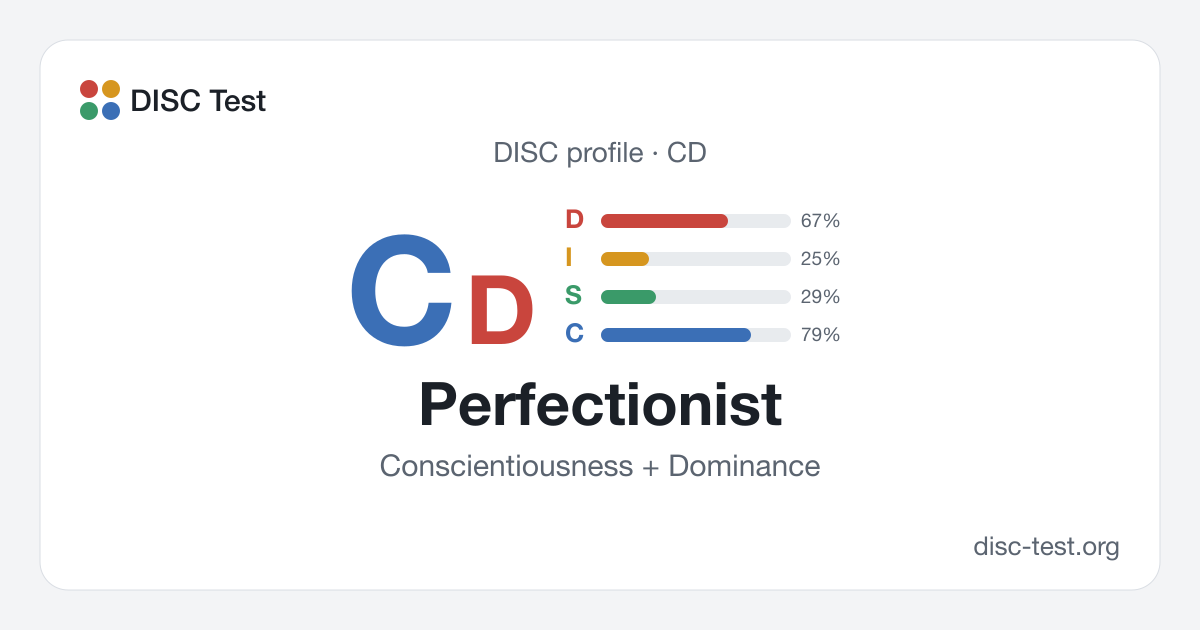
A sample profile for the “Perfectionist” type: the intensity of the four styles in percent; values above 50% are considered high. Your chart will differ in the details, but the shape is similar.
DISC profile
Style intensity
How it differs from similar profiles
The Perfectionist differs from the Strategist (DC) in the order of the letters: quality comes before the goal. The Strategist wants results and demands quality to get there; the Perfectionist wants things done right and is ready to fight for it. What sets them apart from the Analyst (C) is drive: they don’t just see a mistake, they insist on fixing it. From the Expert (CS): less patience and more readiness to argue.
Primary style: Conscientiousness (C)
Accuracy and quality.
Secondary style: Dominance (D)
It gives your primary style more drive, speed and willingness to take charge.
The Perfectionist at work
At work the Perfectionist is the last line of defense before the client: they review, find mistakes, demand fixes and won’t sign off on anything they’re not sure of. They’re strong in demanding expert work: auditing, systems architecture, quality control, research. It’s hard for them when quality is sacrificed to deadlines, and they say so openly.
Suitable roles and tasks
- Audit, control, inspection
- Systems architect, lead engineer
- Scientific research, expert review
- Financial analysis, risk management
- Head of an expert department
On a team
The guardian of quality: sees mistakes before anyone else, demands precision and isn’t afraid to say so. With them the team does better work, but may feel under constant inspection. They should start with what was done well and explain the criteria beforehand, not afterward.
The Perfectionist as a leader
As a leader, the Perfectionist sets high standards and lives up to them. The team works professionally and makes few mistakes. The weak spots are criticism and control: they notice slip-ups faster than successes, redo other people’s work and can create the feeling that they’re impossible to please.
What they need from a manager
The Perfectionist needs a competent manager who values quality and explains why “good” is sometimes good enough. They work well when the criteria are clear up front and decisions are well-founded. Needless rushing, sloppiness and uninformed comments meet stiff resistance from them.
Under pressure and in conflict
Under pressure the Perfectionist becomes sharper and more demanding: they point out mistakes harshly, stop trusting other people’s work and do everything themselves. In conflict they argue with evidence and won’t back down until convinced they’re wrong. They can be right on the substance and still lose on the relationship.
Areas to develop
- Starting feedback with what was done well
- Explaining quality criteria before the work starts, not after
- Telling apart mistakes that matter from those that can slide
- Trusting colleagues with parts of the work without re-checking everything
How to communicate with other styles
With Dominance (D)
Report risks briefly, with an assessment of the consequences, and offer a “good enough for now” option.
With Influence (I)
Start by acknowledging the idea, and keep criticism specific rather than harsh.
With Steadiness (S)
Soften your criticism and acknowledge their contribution out loud — coldness hurts an S more than you might think.
With Conscientiousness (C)
Limit the time for analysis and decide in advance where to stop.
How to reach agreement
Come to the Perfectionist prepared: facts, criteria, logic. Don’t argue with them emotionally. If the work needs to be delivered before they consider it ready, agree on a minimum quality level and on what will be finished later; that eases their inner resistance.
A real-world example
Before a release, the Perfectionist finds twelve issues and demands that the launch be postponed. The project manager asks them to pick the three most important. The Perfectionist agrees, the release goes out on time and the remaining nine are fixed in the next version. The key change is that the criteria for what blocks a release are now agreed on before testing begins.
DISC style compatibility: all pairs →
Similar profiles
Results through quality: you are demanding of yourself and others, think systematically and never decide…
CAnalystC · ConscientiousnessYou rely on facts and standards: you check, analyze, plan and dislike hasty decisions. Quality and getting it…
CSExpertCS · Conscientiousness + SteadinessPrecision and consistency: you work thoughtfully, check the details and rely on proven methods. A dependable…
CIConsultantCI · Conscientiousness + InfluenceAnalysis and connection: you can get to the bottom of a question and explain it to others in plain terms. A…
Other DISC profiles
D AchieverDI PioneerDS DoerI EnthusiastID MotivatorIS MentorIC PresenterS AnchorSI DiplomatSC SpecialistSD Implementer