Doer (DS): DISC Personality Type
Persistence and reliability: you push steadily toward the goal without any fuss and finish what you start. You value independence and stability at the same time, which is a rare combination.
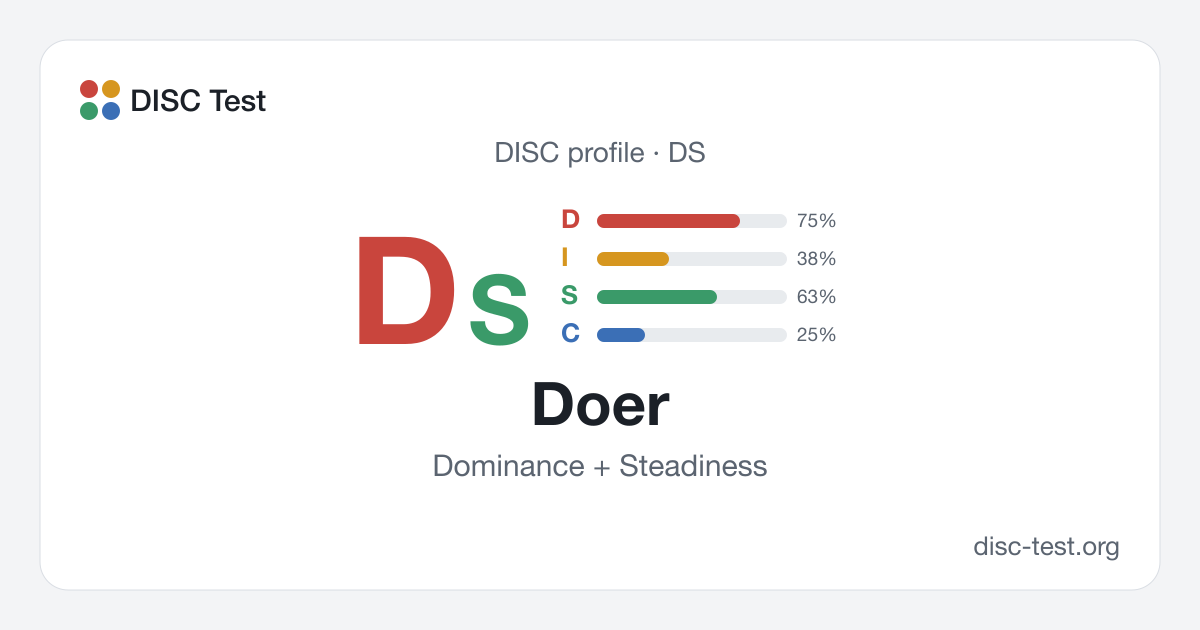
What the result looks like
A sample profile for the “Doer” type: the intensity of the four styles in percent; values above 50% are considered high. Your chart will differ in the details, but the shape is similar.
DISC profile
Style intensity
How it differs from similar profiles
The Doer combines the drive of D with the patience of S, which sets them apart from all their neighbors. The Achiever (D) charges toward the goal faster and more loudly; the Doer gets there steadily and without fanfare. What sets them apart from the Implementer (SD) is the order: for the Doer, the goal and initiative come first; for the Implementer, reliability and calm. From the Pioneer (DI): no need for an audience. They don’t need everyone to see them at work.
Primary style: Dominance (D)
Results and control.
Secondary style: Steadiness (S)
It gives your primary style more patience, reliability and attention to the team.
The Doer at work
At work the Doer is the person who gets told “make it happen”: get the line running, fix the problem area, see the rollout through. They work independently, keep their word and don’t drop a task at the first difficulty. They’re happiest where there’s a concrete result and clear accountability. Endless discussions, office politics and meetings that decide nothing wear them out.
Suitable roles and tasks
- Head of production or operations
- Implementation project manager
- Head of a service department
- Entrepreneur in a stable business
- Middle manager in a large company
On a team
The workhorse: takes on a task and sees it through to the end without fuss, doesn’t abandon it halfway, keeps their word. A rare combination of independence and reliability makes them someone a manager can always count on. To others they can seem stubborn and closed off; they should talk through their plans more often and hear out other options.
The Doer as a leader
As a leader, the Doer is calm, firm and consistent: they assign tasks, check that they’re done and work alongside the team. People know what to expect from them. The weak spots are stubbornness and reticence: they rarely explain their plans, are reluctant to change a decision and may not notice that the team needs discussion and recognition.
What they need from a manager
The Doer needs a manager who sets a clear task and trusts them to carry it out. They value agreements that hold: if the goal changes, they need to understand why. Frequent changes of course, oversight of every step and tasks with no concrete result sap their motivation.
Under pressure and in conflict
Under pressure the Doer digs in: works more, says less and sticks to the chosen path even when the situation has changed. In conflict they don’t make noise, but they don’t give in either, and they may quietly do things their own way. From the outside it looks like stubbornness; from the inside, like commitment to a decision.
Areas to develop
- Talking through plans out loud so the team understands the logic
- Revisiting a decision when circumstances change
- Asking colleagues for their views before taking action
- Delegating, even what would be faster to do themselves
How to communicate with other styles
With Dominance (D)
Agree on the goal and the deadline, but keep the choice of route for yourself — micromanagement kills your motivation.
With Influence (I)
Don’t dismiss their ideas as idle talk, but do ask for a concrete plan.
With Steadiness (S)
Make the call yourself, but explain it and give them time to adjust.
With Conscientiousness (C)
Acknowledge the value of checking and agree on the criteria for “done” in advance.
How to reach agreement
Be specific with the Doer: what needs doing, by when and with what resources. Don’t overload them with justifications, and don’t change an agreement without a reason. If you want them to change their approach, show them the facts and give them time to think; on the spot, they’re more likely to say no.
A real-world example
The Doer is handed a rollout that has already failed twice. Instead of giving presentations, they make a list of problems and fix them one by one. Three months later the system works. Leadership only learns of the progress from the final report, and next time asks them to send a short weekly status update so that success is visible sooner.
DISC style compatibility: all pairs →
Similar profiles
Perseverance and patience: you calmly but firmly see things through without getting caught up in needless…
DAchieverD · DominanceYou head straight for the goal and move fast: you take the initiative, decide without lengthy discussion and…
DIPioneerDI · Dominance + InfluenceDrive and charm: you move quickly toward the goal and know how to bring people along. You win people over…
DCStrategistDC · Dominance + ConscientiousnessResults through quality: you are demanding of yourself and others, think systematically and never decide…
Other DISC profiles
I EnthusiastID MotivatorIS MentorIC PresenterS AnchorSI DiplomatSC SpecialistC AnalystCD PerfectionistCS ExpertCI Consultant